
Estimated reading time: 6 minutes
Date: November 13, 2026
Health category: Prevention and Screening
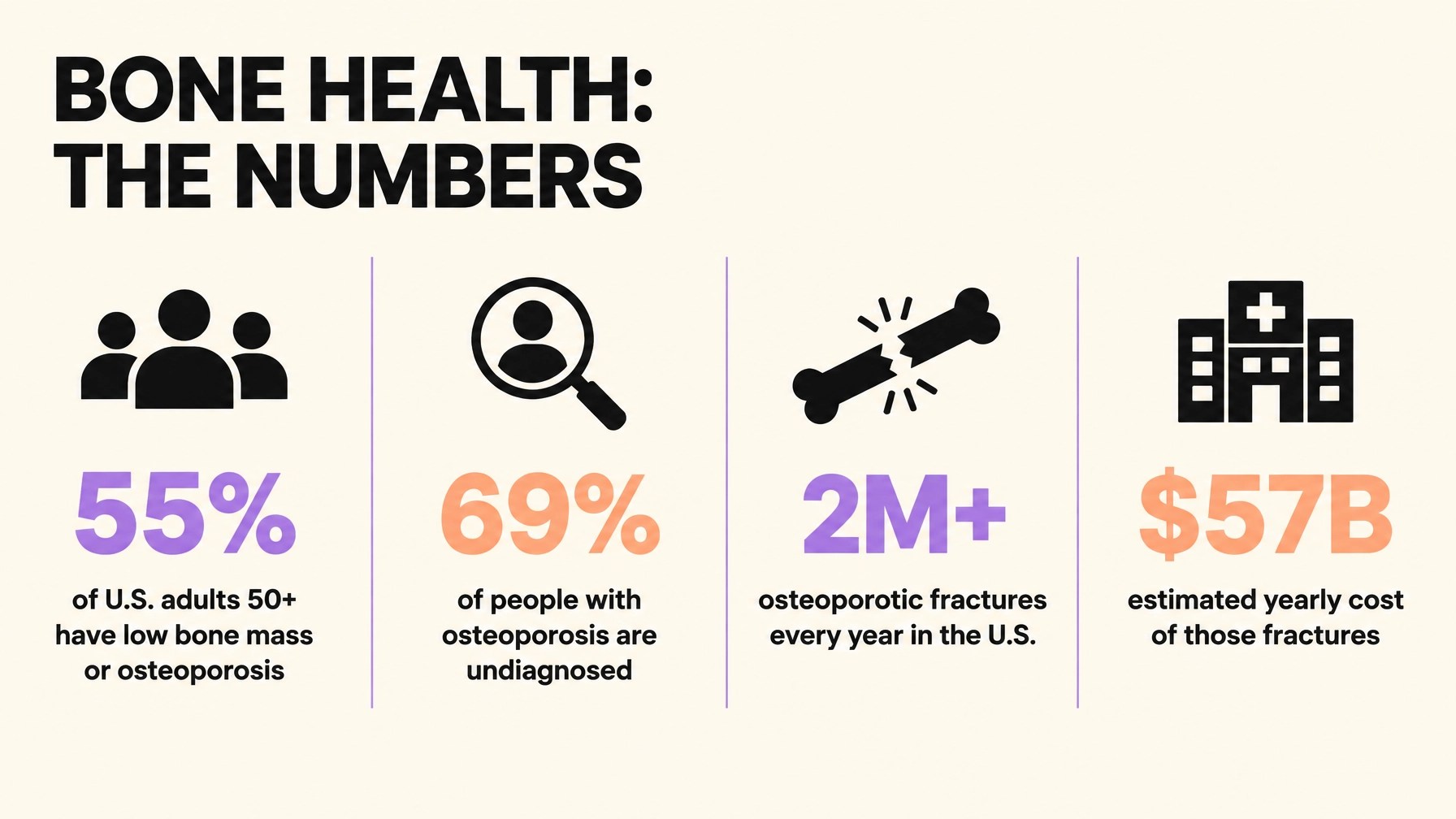
TL;DR: Osteoporosis can develop without noticeable symptoms, and many people who have it are undiagnosed. The Bone Health and Osteoporosis Foundation’s first national public health indicator report says about 55% of U.S. adults age 50 and older have low bone mass or osteoporosis. Ask a healthcare provider whether a bone density test and fracture-risk assessment make sense for you, especially if you meet age-based screening recommendations or have risk factors or a prior fracture.
Want to know more? Continue reading below.
The Bone Health and Osteoporosis Foundation (BHOF) report, released November 12, 2026, brings together national data on bone health, screening, diagnosis, treatment and disparities. Its findings show why bone health deserves attention before a fracture occurs.
1. Osteoporosis can be silent
Osteoporosis is a disease that weakens bones and makes them more likely to break. Bone loss may cause no noticeable symptoms until a fracture happens, which is why osteoporosis is often called a silent disease.
According to the BHOF report, osteoporosis leads to more than 2 million fractures each year in the United States. These fractures can affect movement and independence. The report also cites an economic analysis estimating that osteoporotic fractures cost more than $57 billion in 2016, with costs projected to exceed $95 billion by 2040.
2. Low bone mass and osteoporosis affect many adults
About 55% of U.S. adults age 50 and older have low bone mass or osteoporosis, according to the report. Low bone mass is below-normal bone density; osteoporosis is a more serious loss of bone density and strength.
The report estimates that about 69% of people with osteoporosis are undiagnosed. That estimate rises to nearly 87% among men. These numbers point to a gap in detection, not a reason to assume an individual has the condition.
3. Ask whether a DEXA scan is right for you
A bone density scan, commonly called a DXA or DEXA scan, measures bone mineral density, usually at the hip and spine. It is non-invasive, takes a few minutes, and uses a very small amount of radiation.
BHOF's patient guidance recommends bone density testing for women age 65 and older, men age 70 and older, and anyone who has broken a bone after age 50. It also recommends considering earlier testing for people at increased risk, including:
- Women ages 50–64 and men ages 50–69 with increased fracture risk
- People with a previous fracture
- People taking long-term glucocorticoids or other medications that can affect bone
- People with risk factors such as low body weight or a condition associated with bone loss
Screening decisions depend on individual health and clinical judgment. Ask your provider when testing is appropriate for you.
What the T-score means
A DXA scan reports a T-score, which compares your bone density with that of a healthy young adult. BHOF explains that a T-score of -1.0 or above is normal, a score between -1.0 and -2.5 means low bone mass (sometimes called osteopenia), and a score of -2.5 or below indicates osteoporosis. You can also be diagnosed with osteoporosis with a better T-score if you have already had a fracture or your fracture-risk estimate is high, which is why the whole picture matters more than one number.
4. Risk assessment may include FRAX
A provider may use FRAX, a fracture-risk assessment tool, as part of an evaluation. As described in the BHOF report, FRAX estimates the 10-year probability of a hip fracture and a major osteoporotic fracture. It uses clinical risk factors and can also include bone-density information from a DXA scan.
FRAX is a risk assessment, not a bone density diagnosis. The report notes that fracture-risk calculators can help identify people who may need DXA testing, but they do not replace DXA when a bone density test is indicated.
5. Prior fractures deserve follow-up
A fracture can be an important signal to review bone health, not just an isolated injury. The BHOF report says many people are not evaluated or treated for osteoporosis after a fracture, even though they may be at increased risk of another.
After a fracture, ask whether your care plan includes an osteoporosis evaluation, a review of fracture risk and fall prevention, and follow-up on any recommended treatment. You can also ask whether your care team offers or can refer you to a fracture liaison service, a coordinated approach to post-fracture bone care described in the report.
6. Bone-healthy habits are practical, and worth discussing
The BHOF report recommends bone-healthy habits across life stages. These include:
- Weight-bearing movement, such as walking or stair climbing
- Muscle-strengthening activity, such as resistance exercises
- Balance training and fall prevention
- Adequate calcium and vitamin D, through food and, when needed, supplements
- Not smoking and limiting alcohol
BHOF separately publishes general intake guidance of about 1,000–1,200 mg of calcium daily and 800–1,000 IU of vitamin D daily for adults over 50, along with regular weight-bearing and muscle-strengthening exercise on most days. Individual needs can differ. Ask a provider whether your diet meets your needs, whether a supplement is appropriate, and what a safe movement plan looks like for you.
7. Preventing falls is part of protecting bones
Fall prevention is a core part of fracture prevention in the BHOF report. It recommends strategies such as home modifications and balance training. Ask your provider whether your movement, balance or home environment suggests a need for additional support or a referral.
8. Men and some racial and ethnic groups face gaps in care
The report documents disparities in screening, diagnosis, treatment and outcomes by sex, race and ethnicity, socioeconomic status and geography. It specifically reports that men with osteoporosis are more likely to be undiagnosed than the overall population, and that rural and underserved communities face particular barriers to DXA screening, specialty care and fracture prevention services.
Access to care, cost, distance to a testing center and awareness among both patients and clinicians all shape who gets evaluated. Those are care-system gaps, not shortcomings in patients. If your concerns are dismissed, you can ask for the reason, request that your risk factors be documented, or seek another clinical opinion. If access or cost is a barrier, ask whether there are other ways to arrange testing or follow-up.
9. Ask direct questions at your next appointment
You can read these questions aloud or bring them on your phone:
- “Based on my age and health history, should I have a DXA bone density test?”
- “Could my medications or health conditions affect my bone health?”
- “Would a fracture-risk assessment such as FRAX help guide what we do next?”
- “If I have a fracture, how will we check for osteoporosis and reduce the chance of another one?”
- “Can we review my calcium and vitamin D intake, exercise and fall risk?”
- “If you don’t recommend screening now, can you explain why and when we should revisit it?”
- “If this test isn’t available or affordable for me, what options can we discuss?”
10. Bone health guidance should fit your stage of life
Bone-health questions can come up at different ages and life stages. Gather Round’s expanded Condition Library now includes search filters by age range and life segment (pediatrics, adolescence, midlife and geriatric) so readers can find guidance that better matches their stage of life.
Explore the Gather Round website or download the app on Google Play.
The bottom line: Osteoporosis often develops without symptoms, but screening and risk assessment can help identify concerns before another fracture occurs. If you meet age-based screening recommendations, have a risk factor or have had a fracture, ask your provider what bone-health evaluation is right for you.
Sources
- Bone Health and Osteoporosis Foundation. Bone Health and Osteoporosis National Indicator Report: A Public Health Surveillance and Indicator Analysis. Released November 12, 2026.
- Bone Health and Osteoporosis Foundation. “BHOF Releases First National Public Health Indicator Report on Osteoporosis and Fractures.” November 12, 2026.
- Bone Health and Osteoporosis Foundation. “Evaluation of Bone Health/Bone Density Testing.”
- Bone Health and Osteoporosis Foundation. “Calcium and Vitamin D Requirements, Recommended Foods and Supplements.”
- Bone Health and Osteoporosis Foundation. “How to Implement a Fracture Liaison Service.”