

Estimated reading time: 6 minutes
Date: November 9, 2026, draft for review
Health category: Preventative Health | Heart Health | Health Literacy
TL;DR
You do not have to reach 10,000 steps a day to support your health. Research finds that meaningful benefits are associated with lower daily step counts, with estimates around 2,500–2,800 steps a day in one major analysis. For many people, adding steps gradually from their current baseline is a practical start. More steps are generally linked to more benefit, though the gains tend to level off. These study findings describe population patterns, not a personal guarantee or a required minimum.
want to know more, continue reading below
Where did the 10,000-step goal come from?
The popular target has a memorable history, but it was not established as a universal medical threshold. In 1965, a Japanese company introduced a pedometer called Manpo-kei, often translated as “10,000-step meter.” The number became part of a walking campaign and later a widely repeated fitness goal. A 2023 commentary in the British Journal of Sports Medicine describes this history and notes that 10,000 steps is better understood as a popular target than a biological requirement.[1]
That does not make the goal useless. Some people find it motivating. But if 10,000 feels out of reach, you have not failed, and you do not need to wait until you reach it to benefit from moving more.
What does the research say?
A 2023 meta-analysis in the Journal of the American College of Cardiology combined data from 12 studies and more than 111,000 participants. Compared with 2,000 steps a day, the researchers found statistically significant associations with lower all-cause mortality starting at about 2,517 steps a day, and with lower risk of cardiovascular disease starting at about 2,735 steps a day.[2]
These are not hard cutoffs. They are estimates from observational research. Studies that track patterns in groups of people over time. They cannot prove that a specific number of steps causes a particular health outcome for any one person. They do suggest that health associations can begin well below 10,000 steps a day.
A separate 2023 meta-analysis of 17 cohort studies, including nearly 227,000 people, found that higher step counts were associated with lower all-cause and cardiovascular mortality. The relationship was nonlinear: the largest gains tended to occur as people moved up from lower step counts, with additional benefit still associated with higher counts but generally smaller gains as totals increased.[3] A 2024 review also found a nonlinear association between daily steps and all-cause mortality.[4]
How to interpret the numbers
- Around 2,500–2,800 steps: A point where one major analysis found statistically significant associations for certain outcomes. It is not a prescribed minimum.
- More steps: Higher counts were generally associated with lower risk in large studies, though the relationship was not a straight line.
- 10,000 steps: A possible personal goal, not a universal requirement.
- Your circumstances matter: Age, health, mobility, disability, medications, and starting activity level all affect what is realistic and appropriate.
Step counts are also only one way to measure movement. They do not show every kind of physical activity, and a step counter cannot tell you everything about your health.
How to choose a personal step goal
Start with what you do now, not what someone else’s watch says.
- Check your usual baseline. If you use a phone or pedometer, look at a typical week rather than one unusually active day. If you do not track steps, that is fine, notice when and how you move during a normal day.
- Choose a manageable increase. Add a short walk or another movement break that feels realistic. You might start with a few extra minutes, or a modest increase over your usual daily total.
- Build gradually, if it feels comfortable. If you are recovering from illness or injury, live with a chronic condition, or have concerns about balance or pain, ask a healthcare professional what is safe for you.
- Notice how you feel. A goal should support your wellbeing, not create guilt or pressure. Adjust it when your health, schedule, or access to safe places to move changes.
Any movement can be a starting point
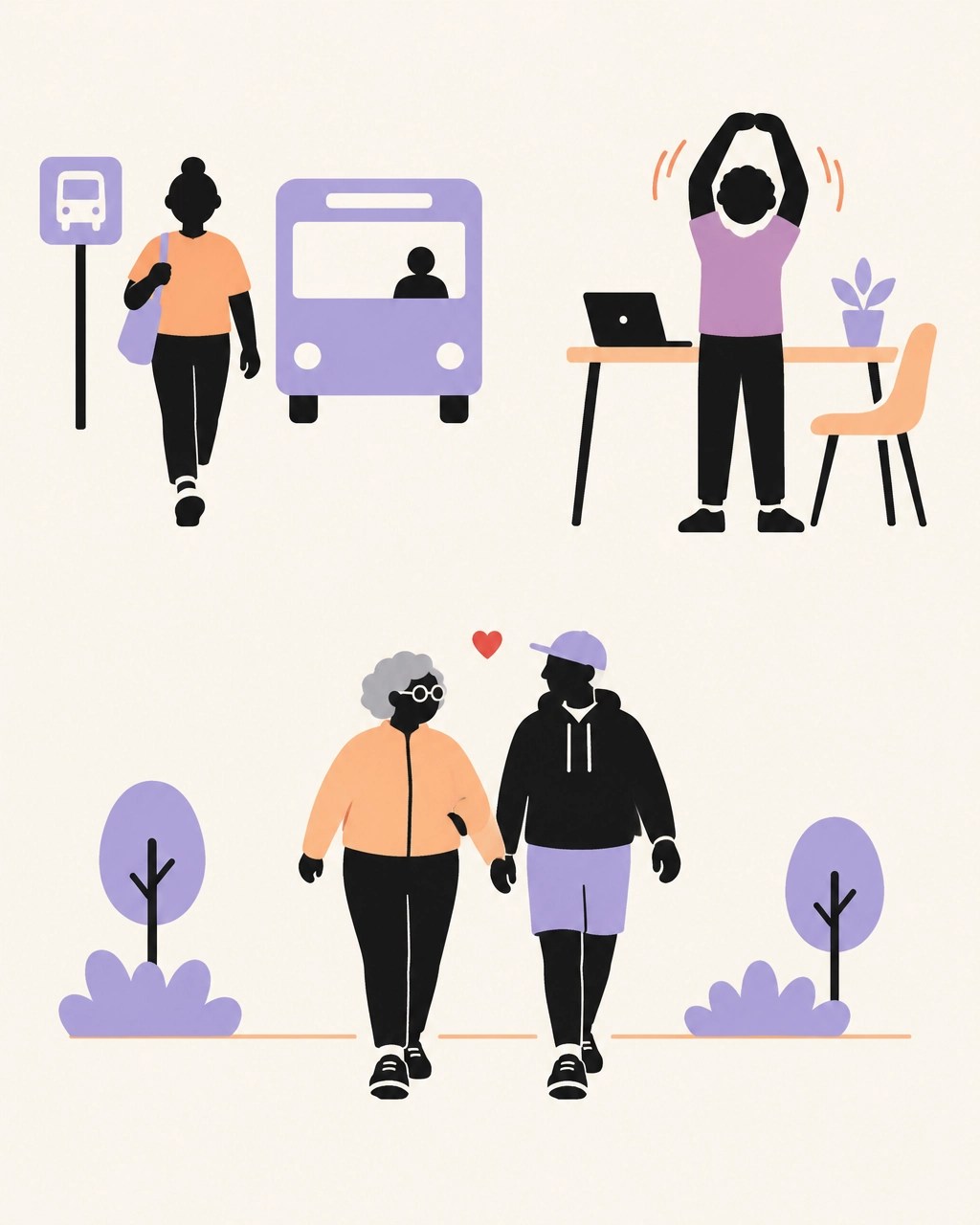
Movement does not have to look like a formal workout. Depending on your body and circumstances, everyday options may include:
- Taking a short walk after a meal or while on a phone call.
- Getting off public transportation one stop earlier, if practical and safe.
- Taking brief standing or stretching breaks during the day.
- Walking with a friend or family member.
- Moving around at home, at work, or in another way that fits your abilities.
Not everyone can walk, and walking is not the only valuable form of movement. If step counts do not reflect your activity, talk with a provider about options that suit your body and needs. The CDC recommends that adults move more and sit less, and describes weekly aerobic activity and muscle-strengthening guidelines, not a daily step requirement.[5]
Access also matters. Safe sidewalks, accessible routes, time, transportation, disability accommodations, and work conditions can shape how much movement is possible. Advice about “just walking more” may overlook these barriers. People should be able to discuss activity goals without being blamed for circumstances beyond their control. Medical bias can also affect whether patients feel heard about pain, fatigue, disability, or mobility limits. You deserve respectful guidance tailored to your situation.
When to seek care
Stop and seek medical advice if movement brings on concerning symptoms such as chest pain, fainting, severe shortness of breath, or sudden weakness. If you have a heart or lung condition, recent surgery, significant joint pain, or a history of falls, ask a healthcare professional how to increase activity safely. Call emergency services for severe or sudden symptoms.
Questions to ask your provider
You could say:
- “I’d like to be more active. What kind of movement is safe for me?”
- “Could my health conditions or medications affect my activity goals?”
- “What should I do if I have pain, dizziness, or shortness of breath while moving?”
- “If walking is difficult for me, what other forms of activity might work?”
Gather Round app update
Gather Round PHA is expanding its Condition Library with new search filters by age range and life stage, including pediatrics, adolescence, midlife, and geriatric health. The goal is to help people find movement and heart-health guidance that is more relevant to their stage of life.
The app offers health education and tools to help users understand their health journey. You can learn more on the Gather Round website or download Gather Round PHA on Google Play.
The bottom line
The 10,000-step goal can be motivating, but it is not a pass-or-fail test. Research links higher step counts with lower risk in large groups, and meaningful associations appear at counts well below 10,000. For proactive wellness, focus on a realistic next step for you. Everyday movement can count, and your goal should fit your health and life, not the other way around.
Sources
- Tudor-Locke C. “The 10,000 steps/day myth.” British Journal of Sports Medicine. 2023.
- Stens NA, et al. “Relationship of Daily Step Counts to All-Cause Mortality and Cardiovascular Events.” Journal of the American College of Cardiology. 2023.
- Banach M, et al. “The association between daily step count and all-cause and cardiovascular mortality: a meta-analysis.” European Journal of Preventive Cardiology. 2023.
- Rodríguez-Gutiérrez E, et al. “Daily steps and all-cause mortality: An umbrella review and meta-analysis.” Preventive Medicine. 2024.
- Centers for Disease Control and Prevention. “What Counts as Physical Activity for Adults.”