

Date: October 9, 2026
Estimated reading time: 5–6 minutes
Health category: Preventative Health / Family Health History
Family health history is one of the most useful tools in preventive care, and one of the easiest to overlook.
Knowing which conditions appear in your family, when they began, and which relatives were affected can help you and your healthcare provider make more informed decisions about screening, monitoring, and prevention. It can support better health risk management, strengthen health literacy, and make proactive healthcare more personal.
Family history is not a prediction. It is information that can help guide the next conversation.
With the Family Health Tree in Gather Round PHA, you can organize health information across generations, notice patterns, and prepare a clearer summary for your care team.
What is a family health history?
A family health history is a record of significant health conditions among biological relatives. Health professionals commonly look at information across three generations, including:
- Parents and siblings
- Children
- Grandparents
- Aunts and uncles
- Nieces and nephews
Useful details include:
- The condition or diagnosis
- The family member’s relationship to you
- Approximate age at diagnosis
- Age and cause of death, when relevant
- Whether the condition affected one or multiple relatives
- Which side of the family it appears on
- Relevant ancestry or cultural background, when voluntarily shared and clinically appropriate
A family pattern may influence when a provider recommends screening or whether a different screening approach is appropriate. This can apply to conditions such as heart disease, high blood pressure, diabetes, certain cancers, osteoporosis, asthma, and some mental health conditions.
Even an incomplete history can be useful. You do not need to know everything before you begin.
Why family history supports prevention
Family history can reflect a combination of inherited factors, shared environments, behaviors, access to care, and social conditions. It gives a provider context that a single appointment or laboratory result may not provide.
For example, a provider may use family history to discuss:
- Earlier screening
- More frequent monitoring
- Different screening tests
- Blood pressure, cholesterol, or blood glucose checks
- Genetic counseling when indicated
- Lifestyle and risk-reduction strategies
- Symptoms that may deserve closer attention
The specific recommendation depends on the condition, the strength of the family pattern, your personal history, your age, and current clinical guidelines. A family history entry should start a conversation, not replace one.
Important: Family history is not destiny. Having a condition in your family does not mean you will develop it. Not having a known family history does not eliminate risk. Family history informs prevention and screening decisions; it does not predict an individual outcome.
What to add to your Gather Round Family Health Tree
Start with what you know. Gather Round PHA lets you organize family members across generations and document conditions or patterns associated with them.
Consider adding:
1. Family members on both sides
Include relatives from your maternal and paternal family when possible. Begin with the people you know best, then add additional relatives as information becomes available.
2. Known conditions
Record major physical and mental health conditions, including those that may have been described using older or informal terms. Examples may include:
- Heart disease or stroke
- High blood pressure
- High cholesterol
- Type 2 diabetes
- Certain cancers
- Asthma
- Osteoporosis
- Thyroid conditions
- Depression, anxiety, or other mental health conditions
- Substance use disorders
- Rare or inherited conditions
You do not need to diagnose a relative yourself. If the name of a condition is uncertain, record what your family member remembers and mark it as unconfirmed.
3. Timing and patterns
Age can matter. “A relative had heart disease” provides less context than “a parent had a heart attack in their 40s.”
When available, add:
- Approximate age at diagnosis
- Whether the condition occurred earlier than expected
- Whether multiple relatives had the same or related condition
- Whether the pattern appears across more than one generation
- Whether a relative died from a known health condition
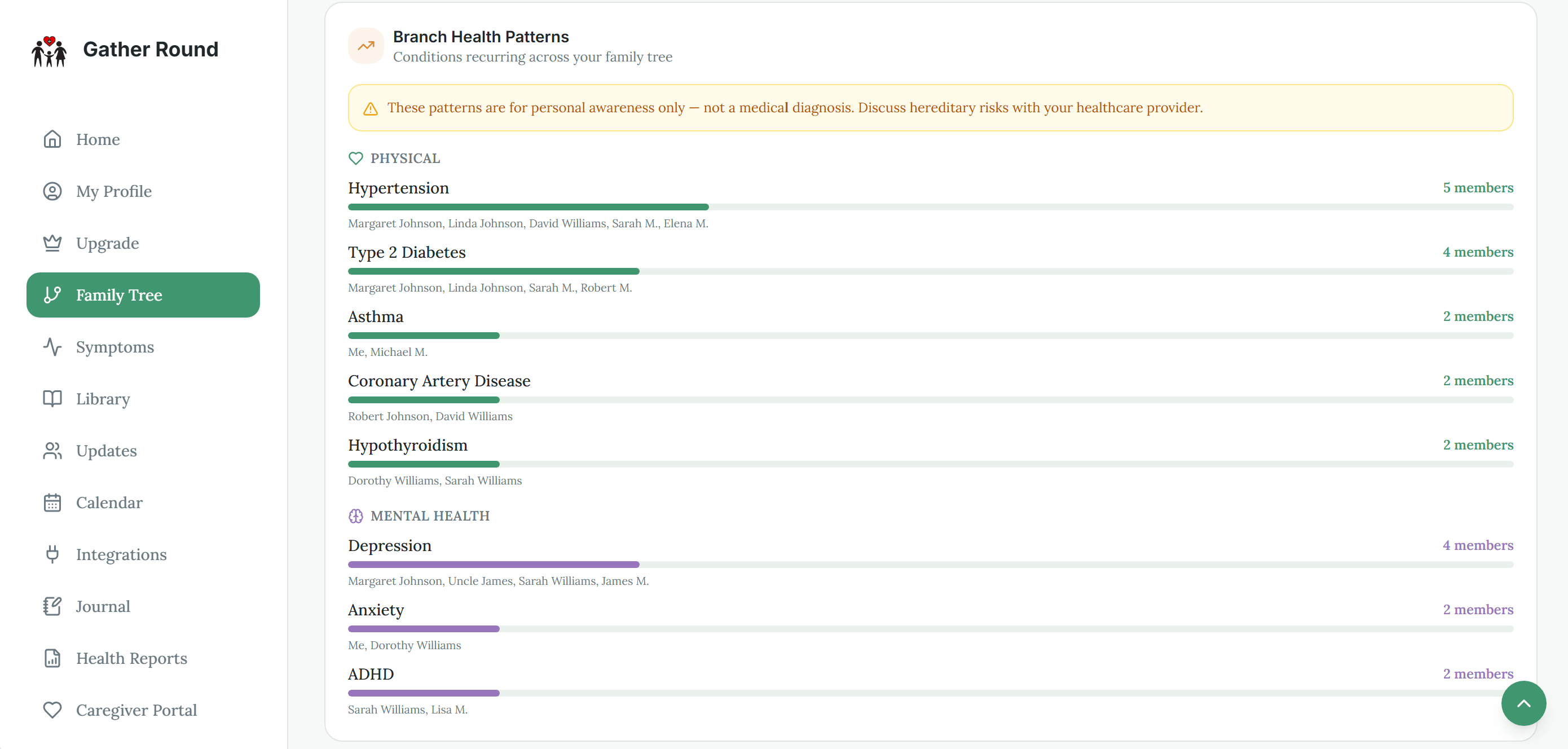
Gather Round’s Branch Health Patterns view can help you see conditions that recur across your family tree. These patterns are for personal awareness. They are not a medical diagnosis.
How to ask relatives about family health history
Health conversations can feel personal. Some relatives may feel uncomfortable, may not remember details, or may have experienced medical care that affected their trust. Approach the conversation with patience and respect.
You might say:
“I’m putting together a family health history so I can have better conversations with my doctor. Would you be comfortable sharing any major conditions in the family and roughly when they were diagnosed?”
Other helpful questions include:
- “Do you remember whether anyone had heart disease, diabetes, cancer, or high blood pressure?”
- “Did anyone develop a condition at a relatively young age?”
- “Do you know what caused a grandparent’s death?”
- “Were there any health conditions people did not talk about openly?”
- “Is there anything you think would be important for me to mention to a healthcare provider?”
You can also ask one question at a time during a family gathering or phone call. Consider confirming important details with more than one relative.
Respect boundaries. Do not pressure someone to disclose sensitive information. If a relative is estranged, unavailable, adopted, or unable to share information, record what is unknown and continue with the information you do have.
Family history, culture, and unequal access to records
Family health history is not equally easy for everyone to collect.
Adoption, estrangement, migration, displacement, family separation, stigma, incomplete medical records, language barriers, and distrust caused by medical mistreatment can all limit access to health information. Some families also use cultural or informal names for conditions that do not match a medical diagnosis.
Missing information is not the same as a negative family history. Tell your provider when information is incomplete rather than assuming that no known history means no risk.
Medical bias can also affect how family history is interpreted. Ancestry and ethnicity may be relevant to some health risks, but they should not be used as shortcuts or stereotypes. A thoughtful provider should consider your individual history, environment, access to care, and lived experience alongside family information.
If you are unsure how to describe your background or family history, you can say:
“I do not have complete information about my biological family, but here is what I know. How should we account for the uncertainty?”
Use the Condition Library to build understanding
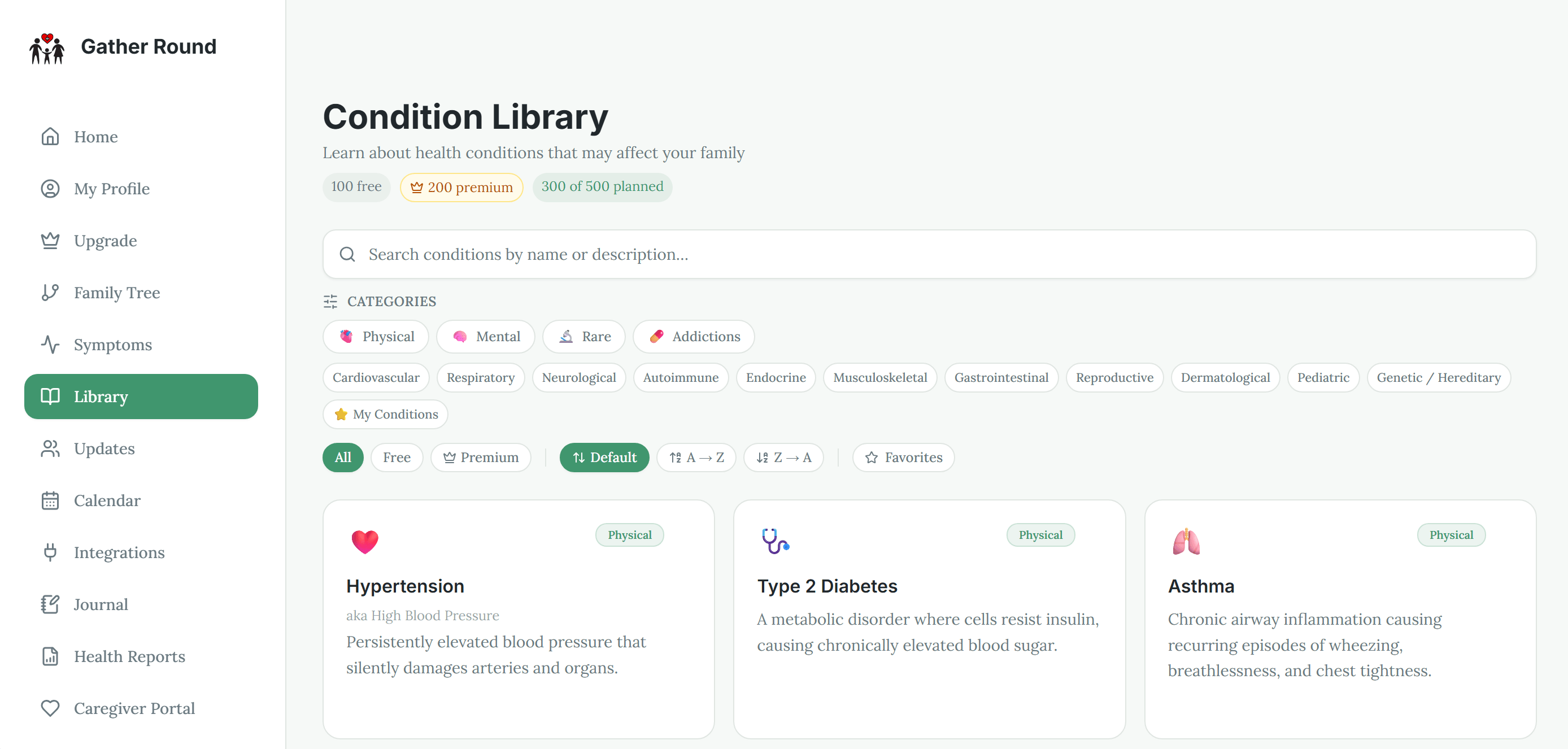
Finding a condition in your family tree may raise questions. Gather Round’s Condition Library provides accessible entries designed to make health information easier to understand.
Use the library to learn:
- What a condition generally means
- Common risk factors
- Signs and symptoms
- Prevention and monitoring considerations
- Questions to bring to a provider
The library supports health literacy, but it does not confirm a diagnosis or tell you which screening you personally need. Use it as preparation for a conversation with a qualified healthcare professional.
You can learn more about the Gather Round app and its preventive-health tools.
How to share your family history with a provider
Before an appointment, review your Family Health Tree and identify the details that seem most important:
- A condition affecting multiple close relatives
- A diagnosis at an unusually young age
- A history of cancer, heart disease, stroke, or diabetes
- A known inherited condition or genetic result
- Important information that remains unknown
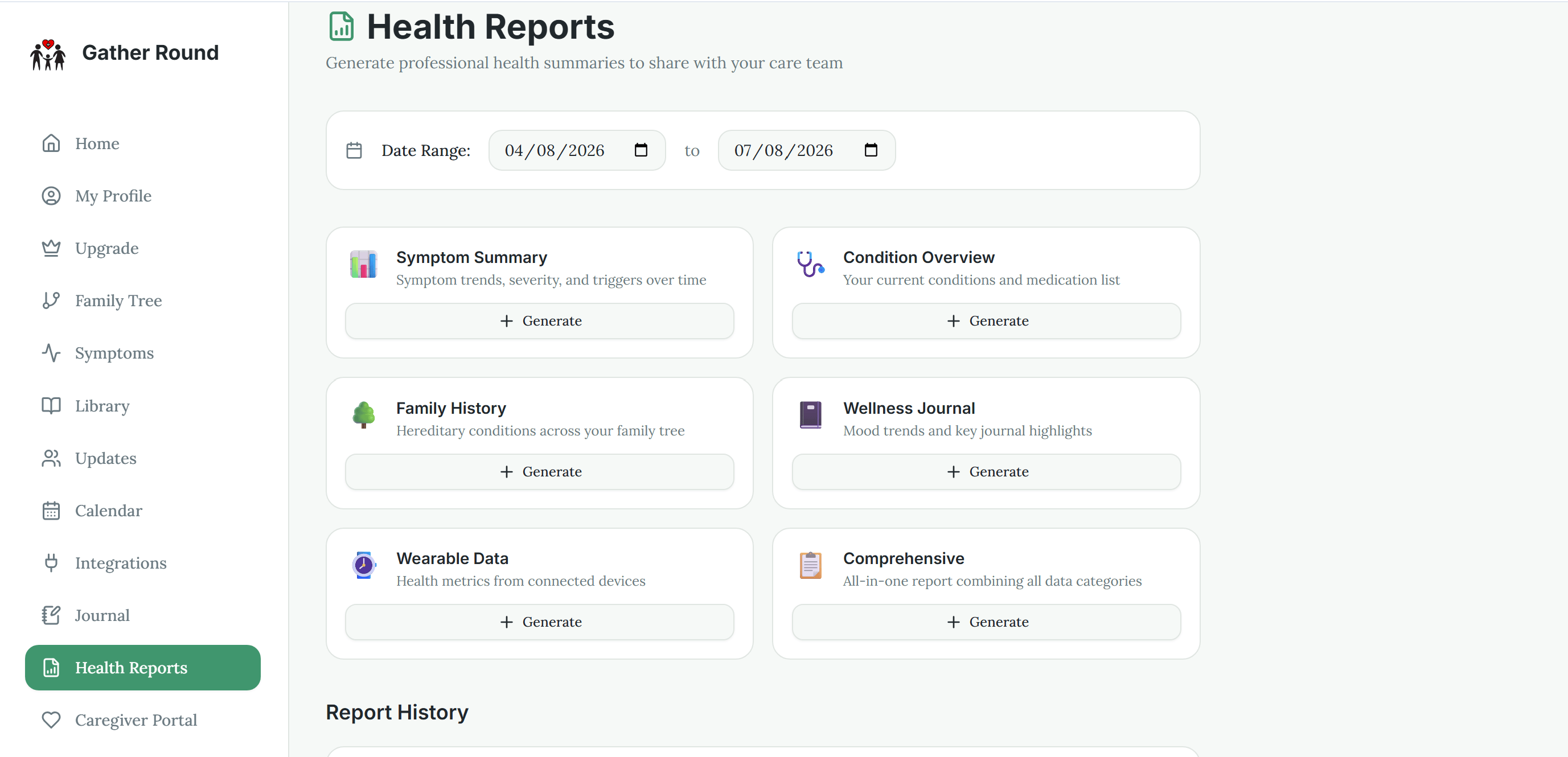
Gather Round’s Health Reports feature includes a Family History report that can help organize hereditary conditions across your family tree. You can use it to prepare a concise summary for your care team.
At your appointment, ask:
- “Does this family history change which screenings I need?”
- “Should I begin any screening earlier than usual?”
- “Do I need a different test or more frequent monitoring?”
- “Would genetic counseling be appropriate?”
- “What symptoms or changes should I report?”
- “What prevention steps would provide the most benefit for me?”
Bring questions, not conclusions. Your provider can interpret the information within the context of current recommendations and your personal health.
How Gather Round protects health information
Gather Round’s privacy policy describes a separated, HIPAA-compliant data pipeline for health information:
- CMS: WordPress powers the public Gather Round website and stores non-PHI website content. Health information is not stored in WordPress.
- App: The Gather Round app, including its interface and logic layer, helps you enter and organize information such as symptoms, health history, and family health patterns.
- Backend: Entered protected health information is stored exclusively in Back4App HIPAA, Gather Round’s HIPAA-compliant backend. The app connects to this backend through the application pipeline; PHI is not stored in the app’s Base44 interface or in the public CMS.
- Safeguards: Gather Round states that it uses encryption, access controls, audit logs, and secure hosting. The company does not sell user data or share PHI with advertisers or non-HIPAA-compliant vendors.
Review the Gather Round Privacy Policy for details about data collection, storage, access, and deletion.
Start with one conversation
Your Family Health Tree does not need to be complete today. Add one relative. Record one condition. Write down one question for your next appointment.
Then, when you are ready, download Gather Round PHA on Google Play and begin building a clearer picture of your family’s health history.
Family history cannot determine your future. But organized information can help you prepare, ask better questions, and take meaningful steps toward preventative health.
Sources
- Centers for Disease Control and Prevention: Family Health History and Adults
- Centers for Disease Control and Prevention: Family Health History
- Centers for Disease Control and Prevention: Family Health History and Cancer
- Centers for Disease Control and Prevention: Preventive Care
- Washington State Department of Health: Family Health History